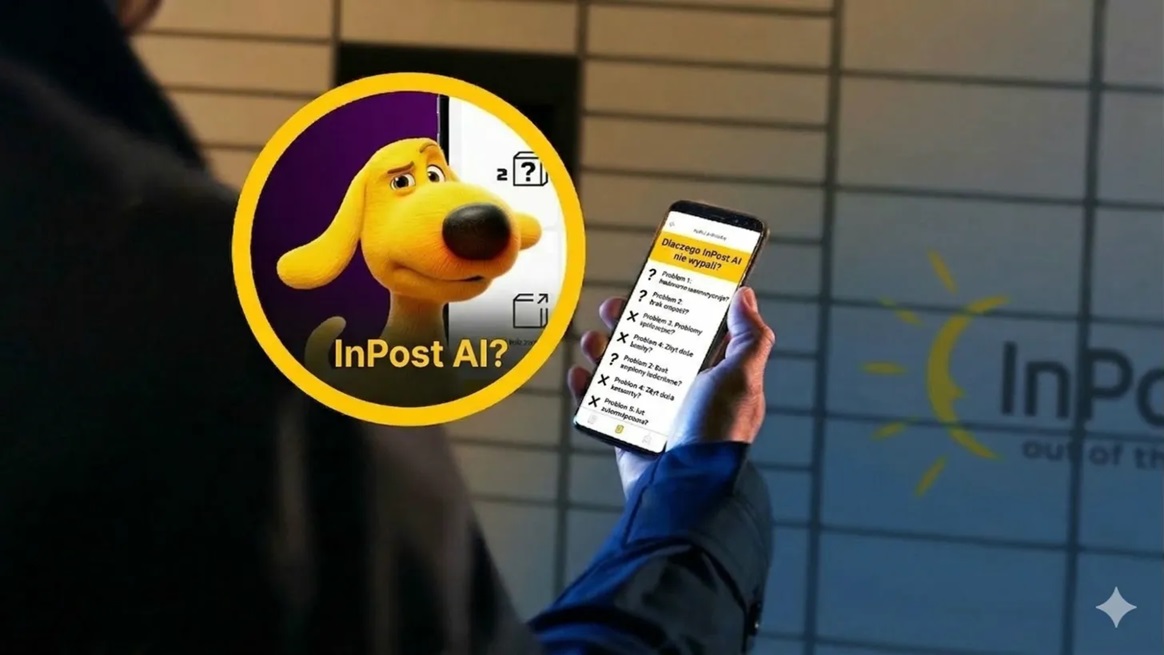
Why InPost AI Will Fail — A Product Analysis
Miłosz Stachaczyk
Head of Product & Agile Consultant
InPost recently introduced an AI assistant — a virtual dog mascot designed to help users operate parcel lockers. The idea sounds innovative, but does it actually solve real user problems? As a Head of Product with 10+ years of experience building digital products, I'm analysing this initiative through a product management lens.
Problem 1: No Real Value for the User
Before evaluating any solution, it's worth asking: what problem does InPost AI actually solve? Parcel lockers are widely regarded as one of the simplest and most intuitive parcel collection systems on the market. The interface is straightforward — scan a code, open the locker, take the parcel. The entire process takes less than 60 seconds.
Adding an AI assistant in the form of a virtual dog to a process that already works well raises a fundamental question: where is the genuine user pain point that this is meant to address? Good products start with a problem, not a technology. If there's no clearly reported, frequently experienced user problem ("I don't know how to collect my parcel"), then building AI around it is a solution without a question.
What's more, introducing AI into a simple interface can paradoxically complicate it. Users who are already familiar with the existing flow will be confused by the new element. Rather than simplifying the experience, the assistant creates an additional step — the last thing users want when completing a routine daily task.
Problem 2: Misalignment with the Target Audience
InPost serves tens of millions of Polish users — from teenagers shopping online, to regular buyers placing weekly orders, to seniors using e-commerce for the first time. That's an extremely diverse user base.
Who is InPost AI actually for? Experienced users — those who collect several parcels a month — don't need a virtual dog. They know the flow by heart. AI is, at best, a novelty for them, not a tool. New users who might genuinely need help with their first collection need simplicity, not a chatbot. A simple animation, a clear step-by-step instruction on screen — that's enough.
There is no user segment that was genuinely waiting for an AI assistant in a parcel locker. This is a classic "technology push" mistake instead of "market pull" — building technology because you can, not because anyone needs it.
Problem 3: Reputational and Social Risk
A virtual dog as an AI mascot carries reputational risks worth thinking through carefully. In an era where trust in AI is generational and social, a gimmick in the form of an animated animal can land ambiguously. Some users will find it fun and fresh. A significant portion — particularly older users or those sceptical of AI — may see it as infantilising.
There's also the risk of meme-ification. If the assistant makes a mistake — doesn't respond correctly, suggests something nonsensical — video clips will find their way onto social media as examples of a failed AI rollout. A single viral fail can define a product for years. We still remember Microsoft Clippy today — and not for positive reasons.
The InPost brand is associated with reliability and simplicity. A virtual AI dog runs counter to that identity. Adding emotional and "cute" elements to an infrastructure brand requires very careful brand identity management.
Problem 4: Cost vs. Value — ROI Remains Unclear
Building a production-grade AI assistant is a massive investment. NLP, model training, multilingual support, backend integration (real-time parcel status updates, error handling), ongoing maintenance and model updates — these are not small costs.
What is the expected ROI? If problems with parcel locker usage are rare — and the data suggests they are, because the system works well — then investing in AI to handle them is hard to justify financially. The costs are certain and high. The benefits are speculative and difficult to measure.
Those same resources could be used to improve the mobile app UX, reduce notification delays, expand the locker network, or improve customer support for edge cases: lost parcels, jammed lockers, scan failures. All of these initiatives have a measurable, direct impact on NPS and user retention.
Problem 5: Alternative Solutions That Actually Solve Problems
Instead of an AI assistant, InPost could invest in several high-ROI initiatives with measurable outcomes:
Predictive notifications: AI that predicts when a user is at risk of missing their collection deadline and sends personalised alerts. Many parcels are returned because users don't react in time. This is where AI genuinely solves a real and costly problem.
Intelligent network optimisation: AI analysing locker location popularity, collection times, and capacity — optimising locker placement and availability. Real value for InPost, even if invisible to the end user.
Better edge case handling: When a locker is jammed, a parcel won't scan, or a code doesn't work — users are left helpless. A chatbot in the mobile app that guides users through these rare but deeply frustrating situations makes genuine sense and has measurable impact on CSAT.
Courier-facing AI: AI supporting couriers with loading decisions, routing, and returns handling — a B2B use case with measurable impact on operational costs and an area where AI has the most to offer.
Conclusion — A Lesson for Product Managers
The InPost AI story is a textbook example of the "AI-first" thinking trap. The technology is available, the market is talking about AI, management wants to "be innovative" — and a product is born that technically works but has no strategic justification.
As a product manager, the first question must always be: what specific user pain point does this solve? The second: is there a simpler solution to this problem? The third: what does measurable success look like for this product in 6 months?
If we can't answer those three questions before launch, we're probably building technology for the sake of technology — not a product for users.
Innovation is not about adding AI to everything. It's about finding real problems and solving them in the simplest possible way.
Want to Discuss This Topic?
Book a free consultation — let's talk through how these ideas apply to your team or career.
Book a Free Consultation